
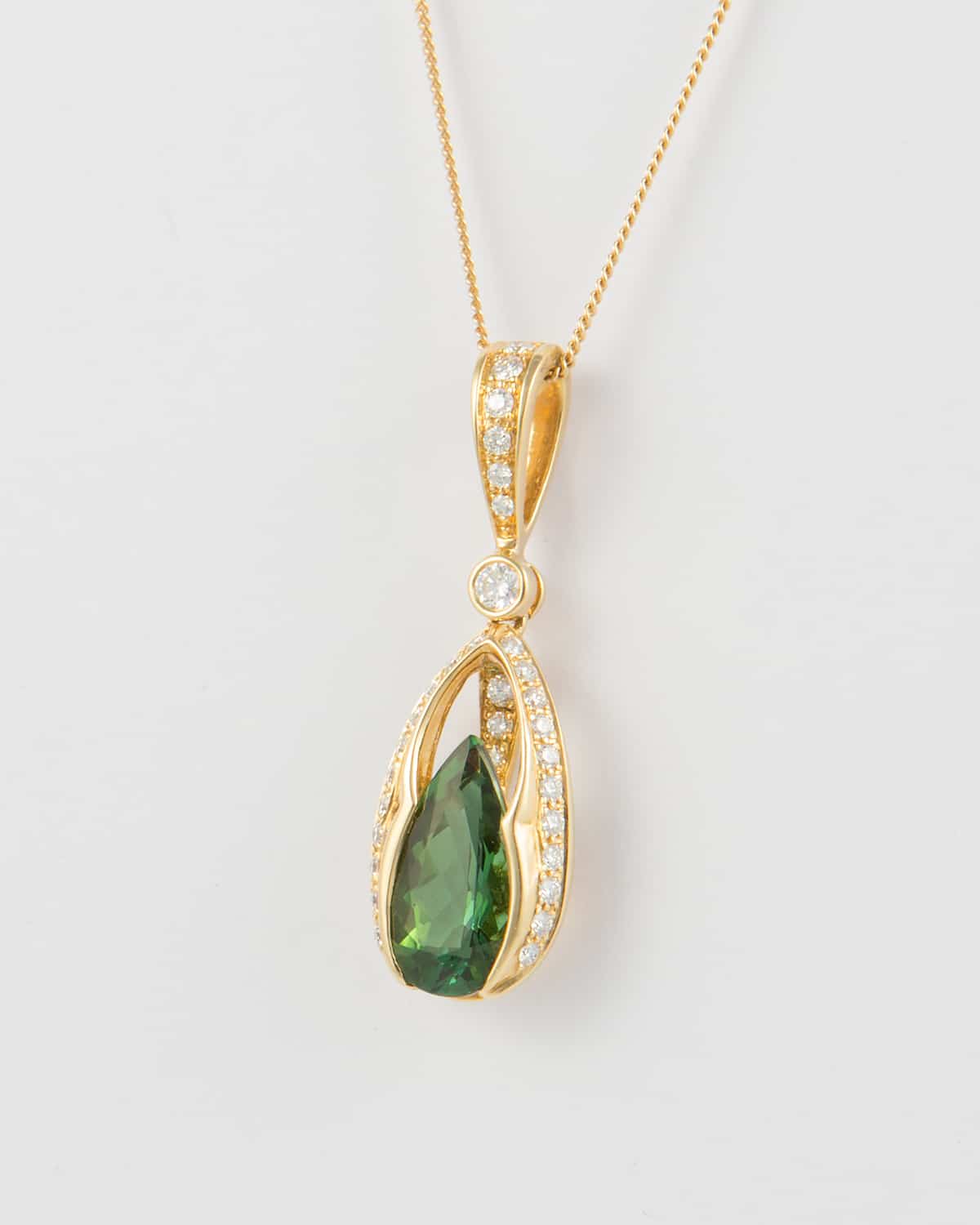
Tourmaline: The Meaning, Colors, and History of October's Birthstone
Tourmaline is the October birthstone, and no other gem carries a wider range of natural color.
A single crystal can shift from pink at one end to green at the other, and the family as a whole covers nearly every hue a jeweler could name.
October claims two birthstones, tourmaline and opal, which gives anyone born this month an unusually broad choice.
Key Takeaways
- Tourmaline is one of two October birthstones, alongside opal, and it marks the 8th wedding anniversary.
- It ranks 7 to 7.5 on the Mohs hardness scale, hard enough for everyday rings and bracelets with reasonable care.
- The name comes from the Sinhalese word toramalli, meaning “stone of mixed colors.”
- Its colors trace to trace elements: manganese for pink and red, chromium and vanadium for green, and copper for the neon blues of Paraíba.
- Because its colors mimic other gems, historic tourmalines were long mistaken for ruby and emerald.
- Heat is its main weakness. Clean tourmaline with warm, soapy water and a soft brush, not steam or ultrasonic machines.

What Is Tourmaline?
Tourmaline is a family of boron silicate minerals that share one crystal structure but differ in chemistry, which is why it appears in more colors than any other gem. Jewelers treat it as a single stone, but as the Gemological Institute of America notes, mineralogists count several related species within the group.
The tourmaline birthstone ranks 7 to 7.5 on the Mohs scale. That puts it comfortably in everyday-wear territory for rings, earrings, and bracelets, though it is softer than sapphire or diamond and dislikes hard knocks.
Most tourmaline is strongly pleochroic, meaning it can show a different color or depth of color depending on the angle you view it from. In a finished stone, that shows up as a face-up color that looks slightly richer or lighter than the same stone seen from the side.
Tourmaline is also the traditional gift for an 8th wedding anniversary, which pairs naturally with its role as an October birthstone.
The Colors of Tourmaline
Tourmaline is valued above all for color, and jewelers use a set of trade names to sort its main varieties. The names describe the look of the stone, not separate minerals.
- Rubellite ranges from vibrant pink through red and purplish red, colored by manganese.
- Indicolite covers blue to blue-green stones, a color rare enough to command a premium.
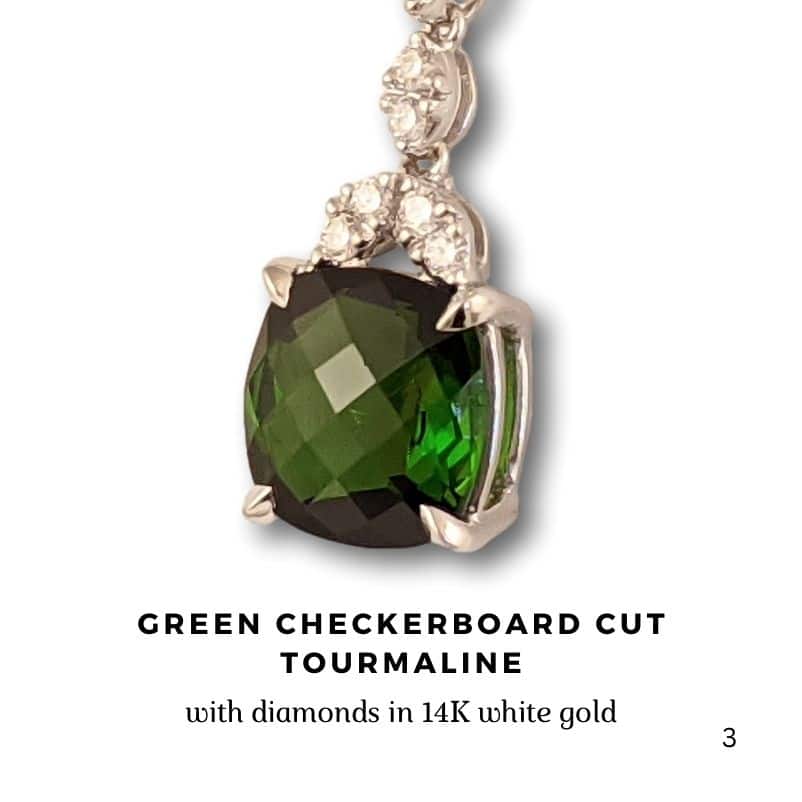
- Chrome tourmaline is an intense green. Its color comes from chromium and vanadium, the same elements that give emerald its green, while most other green tourmaline is colored by iron.
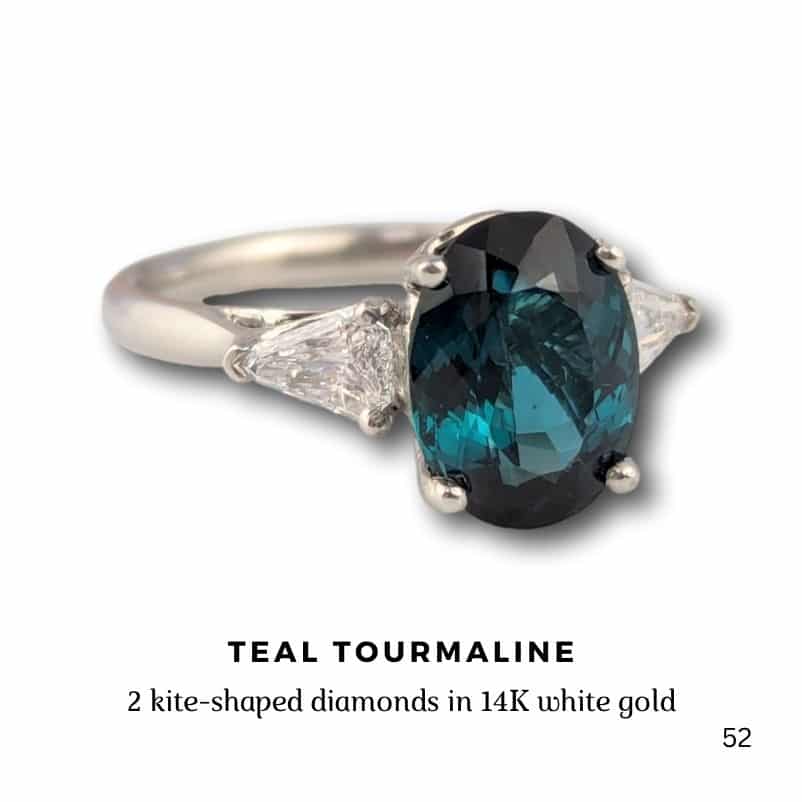
- Paraíba is a neon blue to green, colored by copper.
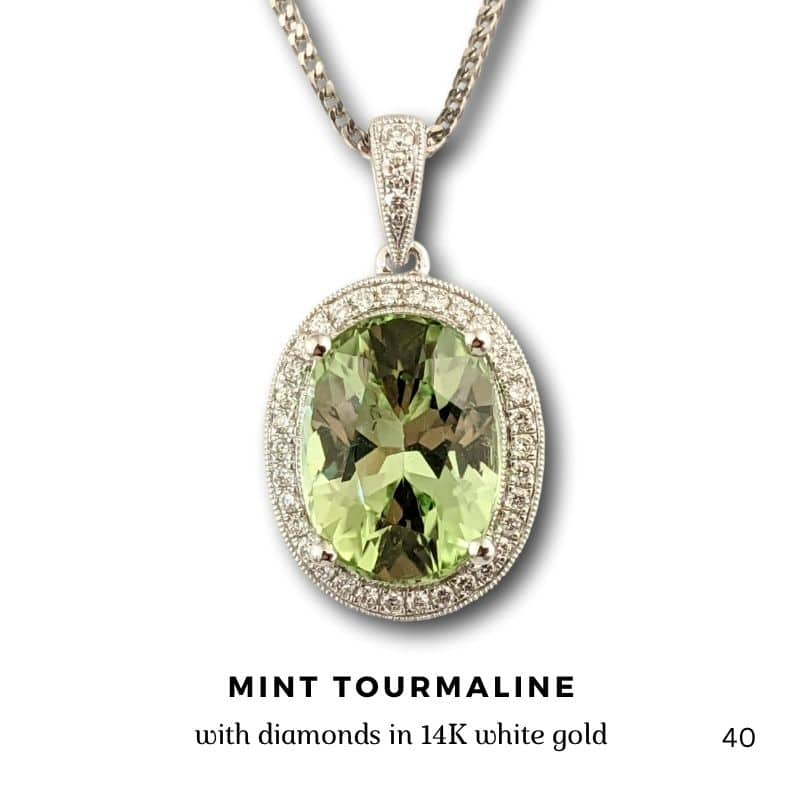
- Parti-colored tourmaline shows more than one color in a single crystal, most often green and pink.
- Watermelon tourmaline has a pink center wrapped in a green rind.
Paraíba, the Neon Blue That Changed the Market
Paraíba tourmaline is colored by copper, which produces a glowing neon blue and green found in no other tourmaline, and it ranks among the most valuable colored stones in the world. Under normal light, it can look lit from within.
The first stones were found in 1989 by prospector Heitor Dimas Barbosa near São José da Batalha in Paraíba, Brazil, after years of digging.
Copper had never been documented as a coloring agent in tourmaline before that find. Similar copper-bearing tourmalines later turned up in Nigeria and Mozambique, so the trade now applies the Paraíba name to copper-bearing stones regardless of origin, while noting the source.
Rough crystals are usually small and heavily included, so faceted Paraíba over one carat is scarce and prices climb quickly.
Watermelon and Bi-Color Tourmaline
Some tourmaline crystals grow more than one color at once, and watermelon tourmaline is the most recognizable example. The color zones form as the chemistry of the growing crystal shifts over time.
Cutters often slice watermelon tourmaline across the crystal so the finished piece shows the pink core ringed by a green rind, like a cross-section of the fruit. Bi-color and tri-color stones follow the same idea with different color pairings.
Why Tourmaline Comes in So Many Colors
Tourmaline’s color range comes down to its crystal structure, which can absorb a long list of trace elements as the stone grows. Small changes in that chemistry produce large changes in color.
- Iron and titanium tend to drive greens and blues
- Manganese produces pinks and reds
- Chromium and vanadium create the rich green of chrome tourmaline
- Copper creates the neon glow of Paraíba
When the available elements change partway through growth, a single crystal can end up with two or three colors along its length.
Where Tourmaline Is Found
Brazil has produced tourmaline for centuries, but fine material now comes from several continents.
East Africa is a major modern source, including Kenya, Tanzania, Madagascar, Mozambique, and Nigeria, along with deposits in Afghanistan and Pakistan.
In the United States, tourmaline comes mainly from Maine and California.
Maine and the First American Gem Tourmaline
The first gem tourmaline found in the United States came out of Mount Mica in Paris, Maine, around 1820. Students Elijah Hamlin and Ezekiel Holmes spotted green crystals near the roots of a fallen tree, and the site became the first commercial gem mine in the country.
Maine later named tourmaline its state mineral. The Newry area, near Plumbago Mountain, produced one of the most famous American finds in 1972, and Maine stones are still prized for their clarity and saturated color.
California has its own chapter. In the early 1900s, the state shipped large amounts of pink tourmaline from San Diego County mines to China, where Empress Dowager Cixi prized the stone for carvings and ornaments. Demand fell sharply after her death in 1908.
A History of Mistaken Identity
Because tourmaline can look like other gems, it spent centuries misidentified as ruby and emerald. Scientists did not recognize it as its own mineral species until the 1800s.
Two famous cases show the pattern. The “Caesar’s Ruby” pendant in the Russian crown jewels is red rubellite tourmaline, not ruby. And in the 1500s, a Spanish conquistador in Brazil mistook a green tourmaline crystal for emerald.
The “Electric Stone”
Tourmaline builds up an electric charge when it is heated or squeezed, a property people noticed long before science could explain it. Heat produces the effect (pyroelectricity), and so does pressure (piezoelectricity).
In the 18th century, Dutch traders who imported the stone from Sri Lanka used warmed tourmaline to pull ash from their pipes and nicknamed it aschentrekker, or “ash puller.” The same electrical behavior later made tourmaline useful in pressure gauges and other scientific instruments.

Tourmaline Meaning and Symbolism
Tourmaline’s meanings have always tracked its colors, so different shades picked up different associations.
Pink is linked to love and compassion, green to vitality and courage, and black to protection and grounding. More broadly, tourmaline has been tied to balance, confidence, and creative expression.
These associations are traditional and are not supported by scientific evidence. Many people still choose tourmaline for the meaning attached to a particular color, which is part of what makes it a personal gift.
How Tourmaline Is Valued
Color drives tourmaline’s value more than any other factor, followed by clarity, cut, and carat weight. This mirrors the Four Cs used to grade diamonds, reordered to put color first.
Vivid, evenly saturated color is the goal. Paraíba and fine chrome green sit at the top of the market, while paler or unevenly colored stones cost far less. Eye-clean stones are preferred, though some varieties such as rubellite and Paraíba are commonly included and still valuable.
Cut matters more than usual because of pleochroism. A skilled cutter orients the stone to show its best color face-up. Heat treatment is common and stable, especially for improving blue and blue-green stones, and it is a standard, accepted practice.
Caring for Tourmaline Jewelry
Tourmaline handles daily wear well, but heat and sudden temperature changes are its weak points. A quick, gentle routine keeps it looking its best.
- Clean with warm, soapy water and a soft brush.
- Avoid steam cleaners and ultrasonic machines, which can harm included stones.
- Keep it away from harsh chemicals and high heat.
- Store it separately from harder stones like diamond and sapphire to prevent scratches, and away from softer stones it could scratch.
Our guide to keeping your jewelry clean at home covers the basics for tourmaline and the rest of your collection.
Explore Tourmaline Jewelry at Copeland Jewelers
One mineral delivering the whole spectrum, colored by tiny differences in its own crystal, and durable enough for a ring you wear every day: that combination is what sets tourmaline apart among birthstones and among colored gems in general.
For an October birthday, it offers something most months cannot, which is a specific color chosen to fit the person.
At Copeland Jewelers in Austin, we work with tourmaline across its color range in custom jewelry and can help you compare stones side by side. Visit our showroom or call to see what is currently available.
Frequently Asked Questions
What is October’s birthstone?
October has two birthstones, tourmaline and opal. Tourmaline is the newer and more durable of the two, while opal is the traditional stone. Both are known for their color.
Is tourmaline a good stone for everyday wear?
Yes. At 7 to 7.5 on the Mohs scale, tourmaline holds up well in rings, earrings, and bracelets with normal care. Protect it from hard knocks and high heat, and it will wear well for years.
What is the rarest tourmaline color?
Copper-bearing Paraíba tourmaline, in its neon blue and green, is the rarest and most valuable. Fine chrome green also commands high prices. Most other colors are more available and more affordable.
What is the difference between tourmaline and topaz?
They are different minerals. Tourmaline is a boron silicate with a much wider color range, while topaz, November’s birthstone, is often confused with blue-green tourmaline by color alone. A jeweler can tell them apart by their physical properties.
Does tourmaline get its color naturally?
Yes. Tourmaline’s colors come from trace elements in the crystal. Some stones are heat-treated to improve their color, which is a stable and standard practice, especially for Paraíba and other blue-green stones.
What does tourmaline symbolize?
Tourmaline is traditionally linked to balance, confidence, and creativity, with color-specific meanings such as love for pink and vitality for green. These meanings are folklore rather than scientific fact, but they remain a big part of the stone’s appeal.