
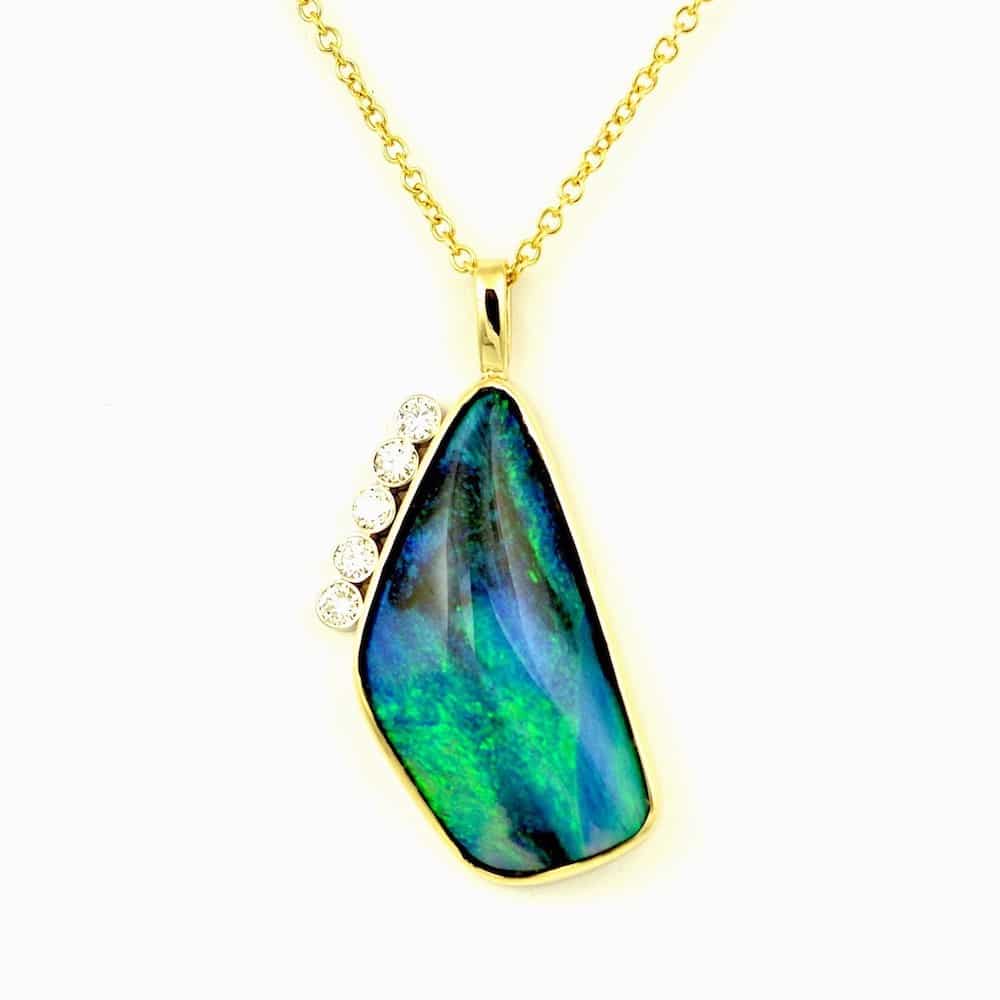
October's Birthstone: A Complete Guide to Opal
Opal is one of two official birthstones for October, sharing the month with tourmaline. The opal birthstone is unusual among gems because its defining feature is not a fixed color but a shifting one. Where most stones are prized for a single hue held steady, opal is prized for the way its color moves across the surface.
Key Takeaways
- Opal and tourmaline are both October birthstones. Opal was named to the modern list in 1912.
- Opal’s shifting rainbow flashes are called play-of-color, caused by microscopic silica spheres bending light inside the stone.
- No two opals match. The internal structure that produces the color forms differently in every stone.
- Opal is soft, ranking 5.5 to 6.5 on the Mohs scale, and holds water inside it, so it needs more care than most gems.
- Fire opal is a separate variety with an orange to red body color, distinct from the “fire” flashes that any precious opal can show.
- The idea that opal is unlucky traces to a single 19th-century novel, not to any older tradition. For most of its history, opal was considered one of the luckiest stones.
- Opal is also the traditional gift for a 14th wedding anniversary.
What Is Opal
Opal is hydrated silica, meaning silica with water locked inside it. Water content usually runs between 6 and 10 percent, though it can range from 3 to 21 percent, and that trapped water is central to both the stone’s appearance and its fragility.
Opal forms when water carrying dissolved silica seeps into cracks and cavities in rock, most often in dry regions where long dry spells follow seasonal rain. As the water slowly evaporates over very long periods, it leaves behind the silica spheres that eventually harden into opal.
The same process can replace organic material. When silica-rich water fills the space left by a shell, a bone, or a piece of wood, the result is an opalized fossil that keeps the original shape while taking on opal’s color.
This is also why opal cannot survive rough treatment the way harder gems can. If the water inside dries out, the stone can craze, developing a network of fine surface cracks.
The Play-of-Color That Sets Opal Apart
The flashing colors inside an opal come from its structure, not from dye or from colored minerals.
Opal is built from countless submicroscopic spheres of silica packed together. When those spheres line up in an orderly grid, they bend passing light into separate colors, the same way a prism splits sunlight. Gemologists call this play of color, and it is the effect people usually mean when they describe an opal’s “fire.”
The Size and Spacing of the Spheres Decide Which Colors Appear
Tighter spacing tends toward blues and violets, wider spacing toward reds and oranges, which is one reason strong red play is the rarest and most valued.
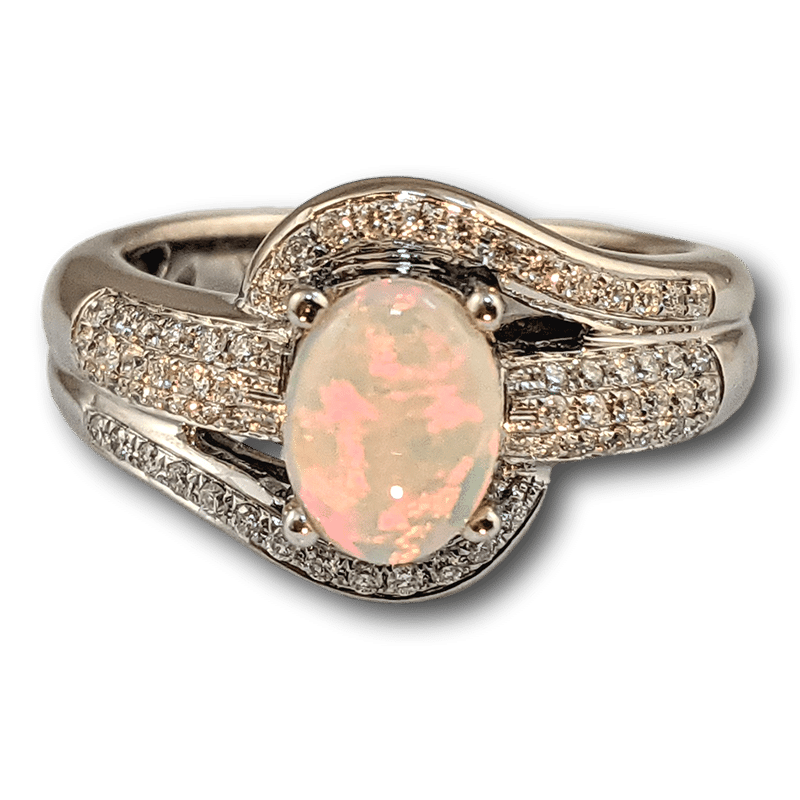
The effect also looks different depending on the stone’s background, showing softly against the pale body of a white opal and far more vividly against the dark body of a black opal.
Opals that show this effect are called precious opals. Those without it are common opals, which can still be lovely but read as a solid or milky color rather than a moving one.
Because the internal grid forms differently in every stone, no two precious opals look the same.
Fire Opals Are a Different Kind of Fire
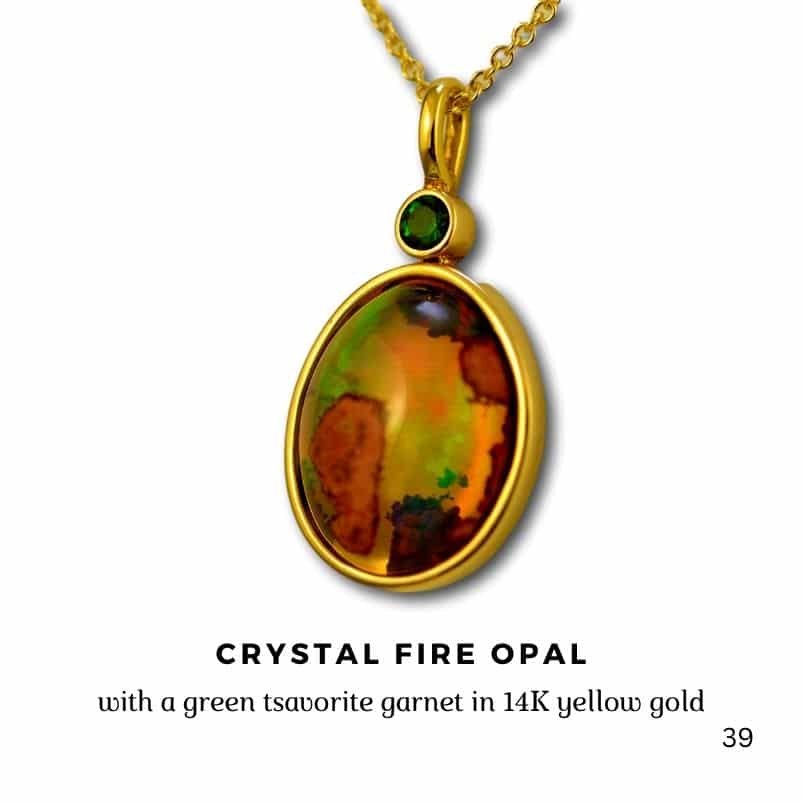
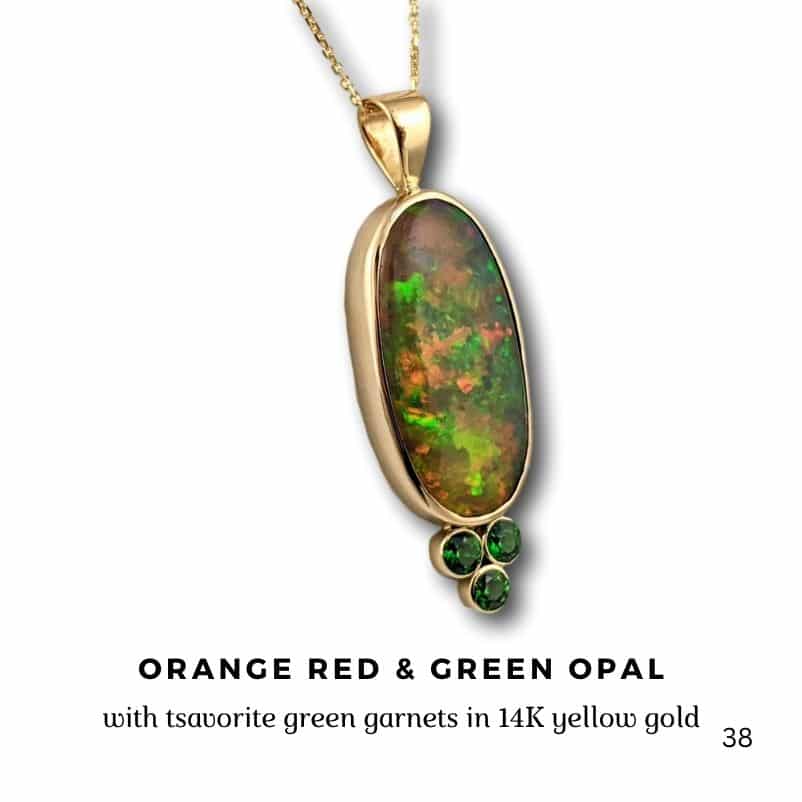
Fire opal refers to opal with a warm body color of yellow, orange, or red, and it is a different thing from the play-of-color flashes described above.
The color comes from traces of iron oxide in the silica. Some fire opals are translucent, some are fully transparent and clear enough to face, and some show play-of-color on top of their warm background while others show none at all.
Because a clear fire opal can be transparent, it is one of the few opals sometimes cut with facets rather than shaped into a smooth dome.
Where Opals Come From
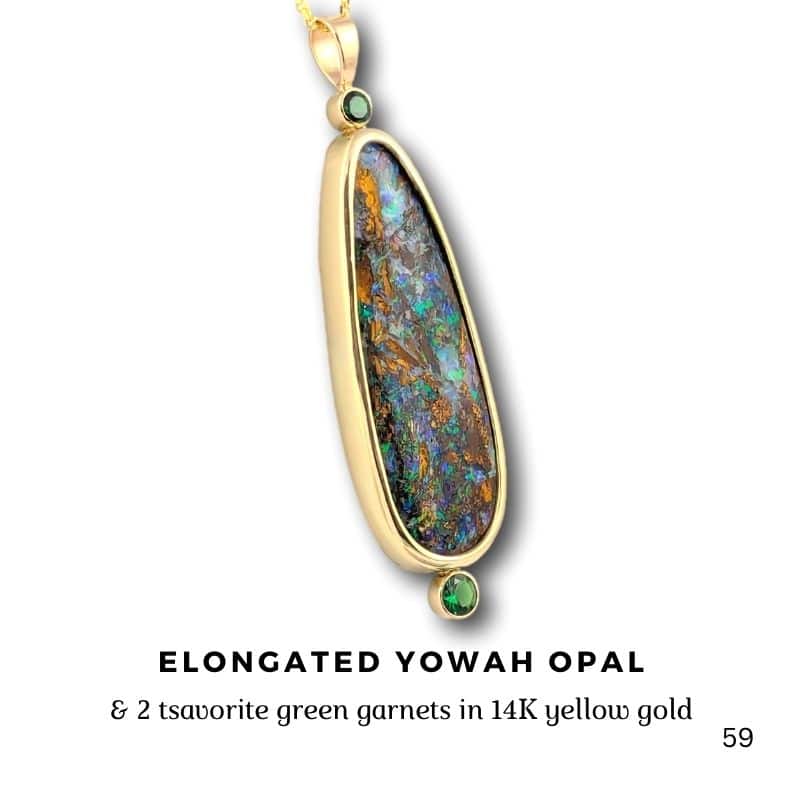
Australia produces the large majority of the world’s precious opal, and it is the country most associated with the stone. Its best-known varieties include the black opal of Lightning Ridge, whose dark body color makes the play-of-color read especially vivid, and boulder opal, which is left attached to a thin layer of its host ironstone to give the soft stone extra support.
Most fire opal comes from Mexico, where it is closely tied to the country’s volcanic geology, with smaller quantities found in the western United States.
Ethiopia has become a major source in recent decades, and additional opal comes from Brazil, Mexico, Peru, and other regions. Opal has even been detected beyond Earth: NASA instruments have identified opal deposits on Mars.
Opal Superstition and Where It Started
The belief that opal brings bad luck comes from fiction, not folklore. It traces to Sir Walter Scott’s 1829 novel Anne of Geierstein, in which a character’s opal loses its color and she dies soon after.
This 19th-century association, built entirely on a novel, was strong enough that European opal sales reportedly fell by half and stayed depressed for years. The related notion that opal is unlucky unless October is your birth month grew out of the same source, not from any older tradition.
Before that novel, opal’s reputation ran the other way. Rome regarded it as the “Queen of Gems,” a phrase often attributed to Shakespeare as well, and the naturalist Pliny the Elder praised a single opal for holding the colors of many other stones at once.
Queen Victoria wore opals openly and gave them to her daughters, which did a great deal to push back against the superstition in her own time.
What Opal Has Symbolized
Across cultures, opal has carried associations with hope, creativity, and clear sight, though these are traditions and beliefs rather than properties of the stone.
An ancient Greek tradition connected opal with the gift of prophecy. Medieval Europeans read shifts in an opal’s brightness as a sign of the wearer’s health and credited the stone with protective powers, including a legend that it could grant invisibility.
Many of these ideas grew from the same trait: a stone that visibly changes as you turn it invites stories about change, insight, and hidden things.

Caring for Opal Jewelry
Opal needs gentler handling than most gems because it is soft and holds water. At 5.5 to 6.5 on the Mohs scale, it is easily scratched by harder stones like diamond, sapphire, ruby, and emerald, so opal should be stored on its own rather than loose in a box with other jewelry.
To clean opal, use warm, soapy water and a soft cloth, and keep it away from ultrasonic cleaners, harsh chemicals, sudden heat, and prolonged dryness, any of which can dull or crack the stone.
Even natural opals can craze if the water inside them dries out. Our guide to keeping jewelry clean covers safe cleaning for softer stones like this in more detail.
Conclusion
Opal stands apart from other birthstones because its color comes from structure rather than pigment. That same water-bearing structure is what makes each stone one of a kind and what makes it delicate enough to need careful handling. Knowing how opal forms is what makes it worth a closer look, whether it marks an October birthday, a 14th wedding anniversary, or simple curiosity about one of the more remarkable things water and silica can make.