
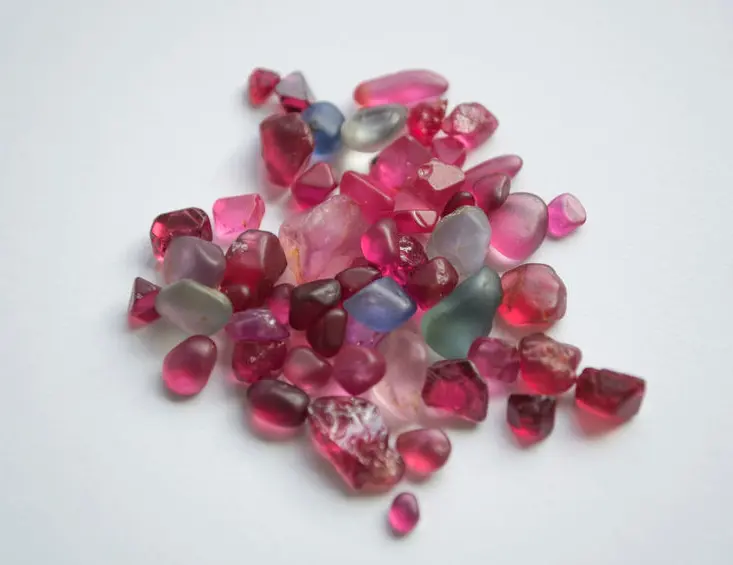
Spinel: August's Birthstone of Color, Rarity, and Natural Character
Spinel joined August’s official birthstone list in 2016, making it one of the most recent additions since the list was formalized in 1912.
That list has changed only three times in over a century, so when the American Gem Trade Association and Jewelers of America added spinel, it reflected something more than a marketing update.
The gem had earned its place through a long record of use in jewelry, a genuinely wide color range, and a history of being confused with stones far more famous than itself.
What Spinel Actually Is
Spinel is a magnesium-aluminum oxide that forms in metamorphic and igneous rock, often in the same geological environments that produce ruby and sapphire.
That shared origin explains a lot – red spinel and ruby can form in the same host rock, appear nearly identical to the eye, and can only be distinguished through chemical analysis.
The GIA’s overview of spinel covers its physical and optical properties in detail for anyone who wants to go deeper into the science.
On the Mohs scale, spinel ranks 8, which puts it in practical territory for everyday jewelry.
It’s harder than most colored gemstones outside of corundum and chrysoberyl, and its crystal structure gives it a single refractive index, meaning it bends light in one direction rather than two.
That optical behavior, combined with its natural brilliance, produces a lively, clean appearance in well-cut stones.
The Color Range
Spinel forms in more natural colors than almost any other single gem species:
- Red
- Pink
- Orange
- Lavender
- Blue
- Violet
- Brown
- Black
- Near-colorless
The color comes from trace elements: chromium produces red and pink, iron drives blue and violet tones, and combinations of those elements create the full middle range.
Deep, vivid red is the most valuable. These stones are genuinely rare and can approach ruby prices per carat when size and saturation are both strong.
Cobalt blue spinel – colored by cobalt rather than iron – is another high-value category, and it shows up far less often than blue spinel in general.
Pastel tones in pink, lavender, and peach have developed a following of their own. They tend to show cleaner, more open color than heavily saturated stones, and they sit well alongside other pastel-toned August birthstones like peridot.
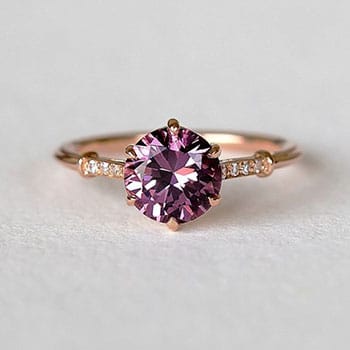
What Spinel Symbolizes
Spinel’s symbolic associations center on energy and endurance.
The stone has long been connected to renewal – specifically the kind that comes from pushing through difficult work rather than starting fresh. That’s a more specific idea than the general themes of love or wisdom attached to other gems, and it gives spinel a different character as a gift.
In traditional crystal healing, spinel color determines placement: each shade corresponds to a different chakra, with red and orange stones mapped to grounding and vitality, and cooler blues and lavenders associated with clarity and calm.
These associations aren’t gemological, but they reflect how the stone’s color range has shaped its meaning across different traditions.
Astrologically, spinel is linked to Sagittarius and Aries – both signs associated with drive and forward momentum, which fits the stone’s broader symbolic profile.
The Historical Confusion with Ruby
Before modern gemological tools, distinguishing red spinel from ruby required more than visual inspection.
Both minerals can occur together, both show vivid red driven by chromium, and both have been collected by the same buyers for centuries. The result is that some of the most celebrated rubies in royal and imperial collections turned out to be spinel once examined properly.
Two of the better-known cases: the 170-carat Black Prince’s Ruby, now set in the Imperial State Crown of the British Crown Jewels, is a red spinel.
So is the 352-carat Timur Ruby, owned by Queen Elizabeth. Neither stone loses its historical importance because of that reclassification, but both show how effectively natural spinel stood in for the most prized gemstone of their eras.
This history also explains the pricing dynamic that still exists. Fine red spinel is rarer than comparable ruby in many markets, yet it remains significantly more affordable because the name recognition isn’t there yet. For buyers who care about the stone itself rather than its category, that gap represents real value.
Natural vs. Synthetic Spinel
Synthetic spinel has been produced in large quantities since the early 20th century. Inexpensive to manufacture, it became a common substitute for diamonds and other gems in class rings, costume jewelry, and commercial pieces. Colorless and light-colored synthetics are especially prevalent.
This history created a reputation problem for the mineral as a whole, which is part of why natural spinel received less attention than it deserved for so long. The 2016 birthstone addition helped, but the reputation gap persists.
One practical note: colorless spinel almost never forms naturally. A colorless stone presented as natural spinel almost certainly isn’t.
For any color, buying from a jeweler who can explain the stone’s source and provide documentation is the simplest protection against synthetic material.
Our team at Copeland Jewelers can help you evaluate natural spinel and compare it against other colored gemstone options in a setting that fits how you plan to wear the piece.
Treatment and Rarity
One of spinel’s strongest selling points for buyers who care about treatment history is that natural spinel is almost entirely untreated.
Unlike ruby and sapphire, which routinely undergo heat treatment to improve color and clarity, spinel generally reaches the market in its natural state. The color doesn’t need adjustment because the crystal already produces clean, vivid tones without intervention.
This is uncommon. Most colored gemstones in commercial circulation have been heated, oiled, or otherwise enhanced.
When a jeweler can confirm that a stone is untreated, that adds both value and transparency to the transaction – and with spinel, that confirmation is far easier to give than it is with most other gems.
Caring for Spinel Jewelry
Spinel’s hardness of 8 makes it a practical choice for rings, earrings, and pendants. It holds up well under regular wear and doesn’t require the same level of protective setting that softer stones need.
For cleaning, warm water and mild soap with a soft brush remove everyday buildup without risk.
Ultrasonic cleaners are generally safe for spinel, though checking setting integrity before use is always a good practice. Avoid harsh household cleaners and chlorine, which can affect metal components over time.
Store spinel separately from diamond jewelry, which can scratch any stone below a 10 on the Mohs scale. A fabric-lined compartment or individual pouch is sufficient.
Our jewelry cleaning and care guide covers the full range of stone types and settings for anyone who wants a complete reference.
Choosing Spinel at Copeland Jewelers
Spinel’s addition to the birthstone list brought more buyers to the stone, but it remains underappreciated compared to the gems it so closely resembles.
For August birthdays, anniversary pieces, or anyone drawn to vivid color without the premium of ruby or sapphire, spinel offers a genuinely different path.
If you’re considering a custom design built around a spinel, the stone’s color range gives real flexibility – a single gem species that spans warm reds, cool blues, and everything between allows the design to lead rather than working around a fixed hue.
You can also browse our custom jewelry gallery to see how different colored stones translate into finished pieces. We’d be glad to walk you through what’s available and help you match color, cut, and setting to how the piece will actually be used.