

Peridot: August's Birthstone of Volcanic Fire and Ancient Light
Peridot has been pulled out of volcanic rock, dredged from a remote Red Sea island, and – in a handful of documented cases – recovered from meteorites. It is one of only two gemstones that forms in the Earth’s mantle rather than the crust, brought to the surface through eruptions and seismic activity over millions of years.
By the time it reaches a jeweler’s bench, it has already traveled further than most stones ever will.
For those born in August, it’s also your birthstone. The peridot birthstone is also the traditional gem for the 16th wedding anniversary, giving it a longer window of relevance than a single month on the calendar.
At Copeland Jewelers in Austin, we work with peridot across custom jewelry designs ranging from birthday pieces to anniversary work. Its yellow-green color is genuinely unlike anything else in the colored stone market, and the range of quality and origin among available stones is wider than most buyers expect.
This guide covers what distinguishes good peridot from average, where the stone actually comes from, and how to care for it once you own it.
What Is Peridot?
Peridot (pronounced pair-uh-doe) is the gem-quality variety of the mineral olivine, a magnesium-iron silicate found throughout the Earth’s mantle. The plural is peridot, not peridots.
Within the species and varieties of olivine, only material with sufficient transparency and color saturation earns the peridot designation.
The stone’s green hue comes from iron within its own chemical structure, not from trace impurities as with most colored gems. This is why peridot exists only in shades of green. There is no blue peridot, no red, no purple.
Iron concentration determines where each stone falls within the green range:
- Pale yellowish green – light and airy, common in lower-iron material
- Lime green – the most commercially available tone
- Grass green – saturated and transparent, the most desirable
- Olive or brownish green – higher iron content, lower value
In very rare cases, peridot arrives from outside the planet entirely, found inside pallasitic meteorites. Extraterrestrial peridot has been recovered and cut into gems, though this material is collector-grade and uncommon in commercial jewelry.
Colors and Quality
The August birthstone peridot occupies a narrower color range than most birthstones, but there is more variation within that range than most people expect.
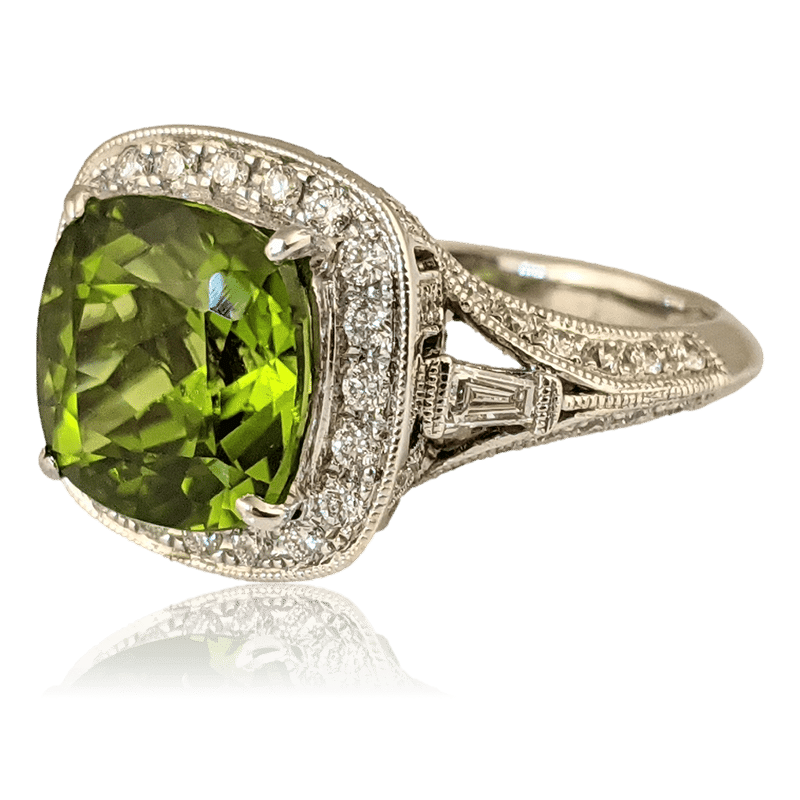
The most desirable color is a vivid, transparent lime to grass green with no brown or olive cast. Stones with a saturated, pure green hue and strong light transmission command the highest prices. As clarity decreases or brownish undertones increase, value drops noticeably.
On the Mohs scale, peridot rates between 6.5 and 7. That puts it in moderate territory – durable enough for pendants, earrings, and rings worn occasionally, but worth protecting with the right setting in pieces intended for daily wear.

Where Peridot Comes From
Peridot crystals form under specific geological conditions, which limit high-quality deposits to a small number of locations worldwide. Large, gem-quality peridot is relatively rare overall, occurring as sizable crystals in only these few places.
San Carlos Apache Indian Reservation, Arizona
The San Carlos Apache Indian Reservation supplies roughly 80 percent of the world’s commercial peridot. This United States source produces affordable, widely available material in a range of qualities. The tribe has mined the deposit for generations, and it remains the largest single peridot source in the country.
Myanmar (Burma)
Historically the source of the finest gem quality peridot, with exceptional color saturation and transparency.
Pakistan
The Kohistan district has produced top-tier material since the 1990s, with some stones matching Burmese specimens in color and clarity.
Island of Zabargad
This red sea island in the Red Sea, also known as St. John’s Island, was mined for more than 3,500 years. It supplied some of the finest peridot on record before the mines closed. The island of Zabargad is no longer in active production.
Sri Lanka
Produces peridot alongside other colored gemstones, with material that occasionally reaches gem quality.
Finland
A smaller but established source of peridot crystals embedded in volcanic rock.
The Name "Evening Emerald"
Roman writers called peridot the “evening emerald” because its green hue stayed visible in low light and lamplight, where most other green stones lost their color entirely.
In ancient times, before reliable artificial lighting, a stone that read as vivid green by firelight was genuinely unusual.
The ancient Egyptians called it the “Gem of the Sun” and mined the island of Zabargad under pharaonic control for centuries. Workers reportedly mined around the clock. Some historians now believe that Cleopatra’s famous emerald collection was actually peridot sourced from Zabargad, as stones from that Red Sea Island were frequently misidentified well into the medieval period.
The most documented case of this confusion involves the Shrine of the Three Holy Kings in the Cologne Cathedral in Germany. The shrine holds what were long believed to be 200-carat emeralds. They are peridot.
Peridot in History and Lore
Peridot’s volcanic origin connected it to specific cultural traditions in ancient times, several of which remain part of the stone’s identity today.
Hawaiian tradition: Peridot represents the tears of Pele, the goddess of volcanoes and fire. Small peridot crystals found in volcanic fields on the Big Island are sometimes called Pele’s tears. The visual connection between the stone and lava fields was observed long before geology explained it.
Ancient Egypt: Peridot was believed to be easier to spot at night due to its glow, so mining on Zabargad was conducted after dark.
Medieval Europe: Through the 18th century and earlier, peridot appeared in ecclesiastical jewelry, royal collections, and manuscript illustrations. Its repeated confusion with emerald reflects how widely it was valued, not how poorly it was understood.
Protection from evil spirits: Across multiple cultures, peridot was worn to ward off evil spirits, nightmares, and fear. The belief that the stone dispelled negative energy was widespread enough to appear in traditions from Egypt to Europe to the Pacific.
Symbolism and Meaning
Beyond warding off evil spirits, peridot carried associations with prosperity and good fortune in early trade cultures, where it was exchanged as a gift between partners and carried by travelers for protection.
One tradition specific to August birthdays holds that people born in this month who do not wear their birthstone will struggle to find a faithful partner – a superstition recorded in historical gem texts and still occasionally cited today.
For a 16th anniversary, it functions as a color-forward alternative to diamond-centric designs, with more visual warmth than most white stones.
How Peridot Is Valued
Color is the primary driver of value. Saturated, pure lime to grass greens with no brownish or olive cast are the most sought after. These other factors shape price alongside color:
- Color: Pure green hue with strong saturation commands a premium. Pale or olive-toned stones drop significantly in value regardless of size.
- Clarity: Eye-clean stones are preferred. Peridot often contains tiny lily-pad-shaped inclusions that, in concentration, cloud the stone’s appearance and reduce light return.
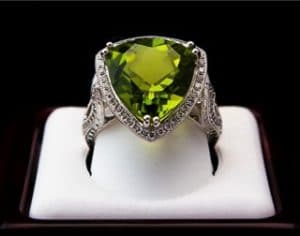
- Cut: Peridot is typically faceted in rounds, ovals, and cushion shapes. A well-proportioned cut distributes color evenly and avoids dead spots where the stone reads flat.
- Carat weight: Larger stones are rarer. Fine material from Pakistan or Myanmar in larger sizes carries a significant premium over comparable Arizona commercial peridot.
- Origin: For collectors, Burmese and Pakistani material commands recognition. Origin documentation adds value for investment-grade stones.
Caring for Peridot Jewelry
Peridot responds well to simple, consistent care. To clean peridot at home, use mild dish soap in warm water with a soft brush, working gently around the setting and rinsing thoroughly. This removes everyday buildup without stressing the stone.
Additional care points worth knowing:
- Avoid ultrasonic and steam cleaners. Peridot is sensitive to thermal shock — sudden temperature changes can cause internal fracturing. This makes the otherwise routine process of ultrasonic or steam cleaning a real risk for this stone, unlike harder gems that tolerate it easily.
- Store separately. Keep peridot away from harder gems like diamonds or sapphires to prevent surface scratching.
- Limit heat and prolonged light exposure. Extended direct sunlight or heat sources can gradually shift the stone’s color over time.
- Choose protective settings. Because peridot sits lower on the Mohs scale than corundum or diamond, bezel or partial bezel settings work particularly well for rings worn daily.
Our team at Copeland Jewelers can walk you through the right setting choice when you bring in a stone or begin a custom piece.
Fun Fact: Peridot from Space
Extraterrestrial peridot has been confirmed in pallasite meteorites, a rare class of space rocks containing olivine crystals embedded in an iron-nickel matrix. When these meteorites are cut open, the olivine inside is sometimes gem quality and facetable.
Extraterrestrial peridot has been sold, though it sits firmly in collector territory rather than the jewelry market.
For everyone else, the United States, Pakistan, and Myanmar offer more than enough variety to work with.
Explore Peridot Jewelry at Copeland Jewelers
At Copeland Jewelers in Austin, we work with peridot across custom jewelry projects ranging from August birthday pieces to 16th anniversary designs. Stop by our showroom to see current peridot in person, or reach out to discuss a custom project. Existing peridot pieces can also be appraised by our certified staff.
For a full look at all twelve birthstone months, visit our Official Birthstone List.