
November's Birthstone: A Complete Guide to Topaz
Tourmaline is the October birthstone, and no other gem carries a wider range of natural color.
A single crystal can shift from pink at one end to green at the other, and the family as a whole covers nearly every hue a jeweler could name.
October claims two birthstones, tourmaline and opal, which gives anyone born this month an unusually broad choice.
Key Takeaways
- Tourmaline is one of two October birthstones, alongside opal, and it marks the 8th wedding anniversary.
- It ranks 7 to 7.5 on the Mohs hardness scale, hard enough for everyday rings and bracelets with reasonable care.
- The name comes from the Sinhalese word toramalli, meaning “stone of mixed colors.”
- Its colors trace to trace elements: manganese for pink and red, chromium and vanadium for green, and copper for the neon blues of Paraíba.
- Because its colors mimic other gems, historic tourmalines were long mistaken for ruby and emerald.
- Heat is its main weakness. Clean tourmaline with warm, soapy water and a soft brush, not steam or ultrasonic machines.

What Is Topaz?
Topaz is a silicate mineral of aluminum and fluorine, and in its pure form it has no color at all. The yellows, blues, and pinks people picture all come from trace elements in the crystal or from later treatment, not from the base mineral.
The topaz birthstone ranks 8 on the Mohs scale. That makes it the hardest silicate mineral, and harder than nearly every colored stone except sapphire, ruby, and chrysoberyl. The GIA’s overview of November birthstones covers its gemological properties for anyone who wants the technical detail.
That hardness is why topaz has been cut and worn for centuries. It resists the scratches and surface dulling that wear down softer stones over years of daily contact.
Hard but Not Tough
Hardness and toughness are two different properties, and topaz scores high on one and low on the other. Hardness measures resistance to scratching. Toughness measures resistance to chipping and breaking.
Topaz has perfect cleavage, meaning it splits cleanly along one internal plane. A sharp enough blow in the wrong direction can cause it to break along that plane even though the surface would shrug off a scratch.
Cutters manage this by orienting the stone so the cleavage sits at roughly a 15-degree angle to the flat top facet, which lowers the risk during cutting and setting.
For a buyer, the takeaway is simpler. Topaz is an easy, durable choice for earrings and pendants, which rarely take direct hits. In a ring worn every day, it earns a protective setting and a little more care than a sapphire would need.
The Colors of Topaz
Colorless topaz is the starting point, and every color on the market traces back to either a trace element or a treatment. Iron and chromium impurities, plus defects in the crystal structure, account for the natural range.
- Yellow to golden brown
- Orange
- Pink
- Blue
- Violet
- Light green
- Red, which is the rarest of all

Imperial Topaz
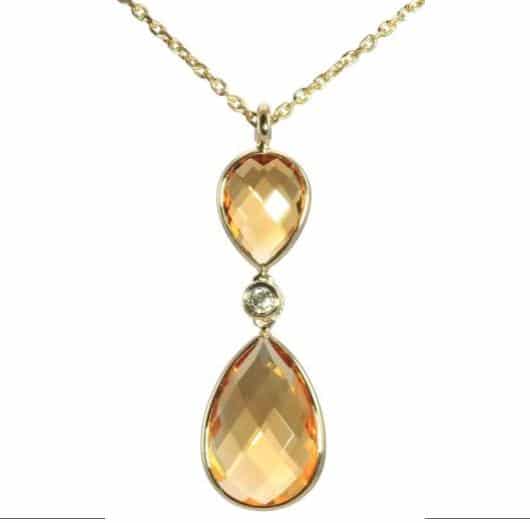
Imperial topaz is the most valuable natural variety, showing a warm golden orange often flushed with pink. Fine stones can shift between orange and pink depending on the light and the angle.
Almost all of it comes from a single region: the mines around Ouro Preto in Minas Gerais, Brazil. That single-source supply, combined with genuine scarcity in strong colors, keeps imperial topaz priced well above the treated blues most shoppers encounter first.
Blue Topaz and Treatment
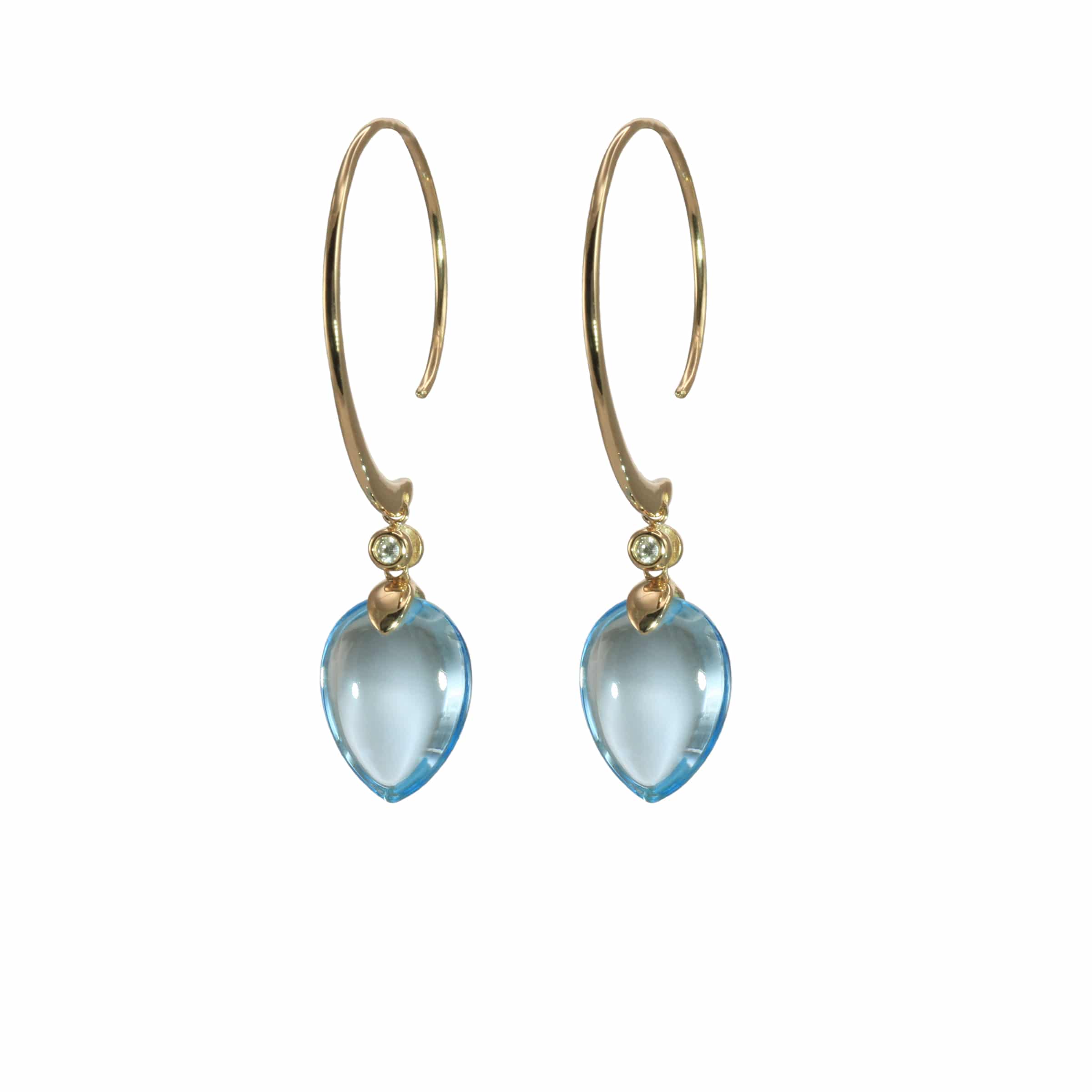
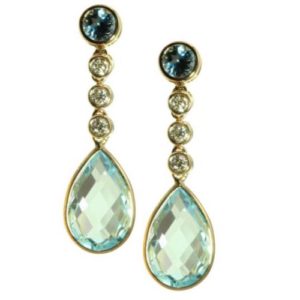
Nearly all blue topaz sold today began as colorless topaz and was turned blue through irradiation followed by heat. This is standard, stable, and disclosed practice, and it is the reason blue topaz is one of the best-value blue gems available.
The trade sorts it by depth of color, from pale Sky Blue through brighter Swiss Blue to the deep, inky London Blue. A single color family in several tones makes blue topaz easy to build matched sets around.
Natural blue topaz does exist, but it is pale and uncommon. When a stone shows a vivid blue, treatment is almost always the reason, and no reputable jeweler treats that as a mark against it.
Mystic Topaz Is a Coating
The oil-slick rainbow of Mystic Topaz is not the stone’s own color. It is a thin metallic film applied to the surface of colorless topaz, which splits light into shifting colors.
The coating holds up to normal wear, but it sits on the surface rather than running through the stone. Abrasive cleaners, buffing wheels, or a hard scratch will strip it, so a Mystic Topaz piece needs gentler handling than the mineral itself would suggest.
Topaz and Texas
Blue topaz is the official Texas state gem, and for an Austin buyer that is more than trivia.
The Texas Legislature named it in 1969, honoring the natural pale-blue topaz found in Mason County in the Hill Country, the only place in the state where it occurs in the wild.
In 1977 the Legislature went further and adopted the Lone Star cut as the official state gemstone cut, the only such designation any state has. The cut places a five-pointed star at the center of the stone, echoing the Lone Star.
Native Texas blue topaz is genuinely pale, a soft sky tone rather than the saturated blues that come from treatment. That makes a naturally blue Mason County stone a regional specialty rather than a stock item. We keep Lone Star topaz pieces in the showroom cut to reveal that center star, which is a piece of Texas most people do not realize they can wear.
What Topaz Has Symbolized
Topaz has carried associations with strength, clarity, and protection across a long list of cultures, though these are traditions rather than properties of the stone. Ancient Rome and Egypt tied it to their sun gods, reading its golden color as a piece of the sun itself.
During the Renaissance, Europeans believed topaz could break spells and settle anger. Ancient Hindu tradition treated it as sacred and credited it with bringing wisdom and long life, and various cultures held that it guarded against sudden death.
The stone also picked up a run of medical folklore. One belief held that powdered topaz stirred into wine could ease asthma or insomnia. Another claimed that rubbing the eyes with a topaz soaked in wine for three days sharpened vision.
None of this holds up, but it shows how much meaning a striking golden stone could gather before anyone understood what it was.
The Name and a History of Mistaken Identity
Topaz spent much of its history confused with other stones, starting with its own name. Many gemologists trace “topaz” to Topazios, an island in the Red Sea, but the yellow-green gem mined there in antiquity was almost certainly peridot, not topaz as we define it now. The name attached to the wrong mineral and stuck.
For centuries afterward, almost any yellow stone got called topaz, including a great deal of yellow quartz. That loose usage is part of why citrine and topaz still get tangled together in casual conversation.
The name Imperial Topaz has two competing origin stories. One credits Russia, where topaz mined in the Ural Mountains was reserved for the czars during the nineteenth century. The other credits Brazil, where the town of Ouro Preto is said to have presented Emperor Pedro II with a reddish topaz in 1881.
Both accounts point to the same idea: the finest topaz was set aside for royalty.
Where Topaz Comes From
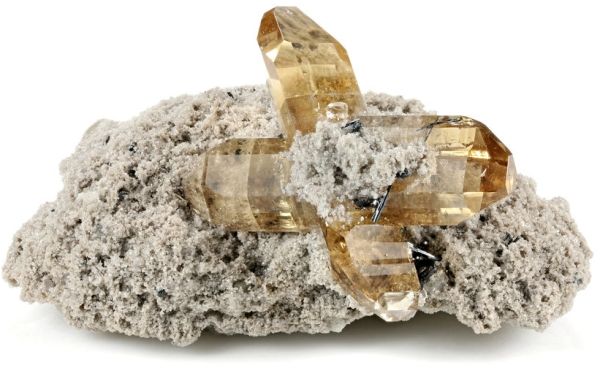
Brazil is the dominant source of gem topaz, and Minas Gerais in particular supplies most of the imperial material and much of the rough that becomes treated blue. Fine topaz also comes from Sri Lanka, Nigeria, Namibia, Madagascar, Mexico, Myanmar, and the historic Russian localities, along with deposits in Utah and Texas in the United States.
Topaz crystals grow to remarkable sizes, which is why museums prize them. The American Museum of Natural History displays a single topaz crystal from Minas Gerais that weighs 271 kilograms, or nearly 600 pounds, which the museum describes as the largest known.
How Topaz Is Valued
Rarity of color drives topaz value more than size does. Natural imperial, pink, and red command the highest prices, while treated blue and colorless topaz sit at the accessible end of the market.
Clarity expectations run high for topaz. Because the mineral commonly forms eye-clean, visible inclusions count against a stone more than they would in an included gem like emerald or rubellite tourmaline.
Cut quality matters for a reason specific to topaz. A skilled cutter has to respect the cleavage while still bringing out color and brilliance, and a well-oriented stone returns more light without sitting fragile in its setting.
Caring for Topaz Jewelry
Topaz needs gentler cleaning than its hardness suggests, and the rules trace directly back to its cleavage and its sensitivity to heat.
Never use an ultrasonic or steam cleaner on topaz. The vibration can find the cleavage plane, and sudden heat or a sharp temperature change can cause internal breaks.
Warm water, mild soap, and a soft brush handle everyday buildup safely. That is the whole routine for most topaz jewelry.
Keep topaz out of prolonged direct sunlight and away from high heat, since long exposure can fade some yellow-to-brown stones over time.
Store it separately from harder stones like diamond and sapphire, and away from softer stones it could scratch, so nothing knocks against its cleavage in a drawer.
Mystic Topaz is the exception that needs the most restraint. Clean it with mild soap only, and keep it away from anything abrasive that could lift the coating.
Our guide to keeping your jewelry clean covers safe handling for topaz alongside the rest of a collection.
Explore Topaz at Copeland Jewelers
We work with topaz across its full range in our Austin showroom, from treated blues in Sky, Swiss, and London tones to natural imperial and the pale Lone Star topaz that ties the stone to Texas. Color reads differently in person than on a screen, and setting a treated blue next to a natural imperial makes the price gap between them easy to see.
If you are drawn to a specific color or want a stone set the way it will actually be worn, a custom piece lets the design account for topaz’s cleavage from the start rather than working around it later. Our custom jewelry gallery shows how different colored stones translate into finished work.
Frequently Asked Questions
What is November’s birthstone?
November has two birthstones, topaz and citrine. Topaz is the traditional stone, prized for its color range and hardness, while citrine was added in 1952 as a more affordable alternative. Both lean toward warm autumn colors.
Is topaz a good stone for everyday wear?
Yes, with one caveat. At 8 on the Mohs scale, topaz resists scratching well enough for daily wear, but its cleavage means a hard blow can chip or split it. It is an easy choice for earrings and pendants, and a fine choice for rings in a protective setting with reasonable care.
Why is most blue topaz treated?
Natural blue topaz is pale and uncommon, so the vivid blues most people want are created by irradiating and heating colorless topaz. The process is stable and standard across the industry, and it is the main reason blue topaz costs far less than other blue gems like sapphire or aquamarine.
What is the difference between imperial topaz and blue topaz?
Imperial topaz is a rare natural variety in golden orange to pinkish tones, mined almost entirely in Brazil, and it sits at the top of the market. Blue topaz is nearly always colorless topaz treated to a blue color, and it is one of the most affordable colored stones available. The gap in rarity is why their prices are so different.
Is blue topaz really the Texas state gem?
Yes. Texas named blue topaz its official state gem in 1969, based on the natural pale-blue topaz found in Mason County in the Hill Country. In 1977 the state also adopted the Lone Star cut, which sets a five-pointed star in the center of the stone, as its official gemstone cut.
What is Mystic Topaz?
Mystic Topaz is colorless topaz coated with a thin metallic film that reflects a rainbow of colors. The effect comes from the surface treatment, not the stone itself, so it needs gentle cleaning with mild soap and no abrasives to avoid stripping the coating.