

Moonstone: One of June’s Most Distinctive Birthstones
June is one of the few months with multiple official birthstones. Alongside pearl and alexandrite, moonstone offers a very different experience of beauty.
It does not rely on sharp sparkle or high contrast. Instead, it responds to light slowly, revealing movement beneath the surface rather than on top of it.
Moonstone has been valued for centuries because it feels expressive rather than decorative. The stone rewards close attention. Its character becomes clearer the longer you look at it, especially when worn rather than viewed loose.
At Copeland Jewelers, moonstone often appeals to clients who want a birthstone that feels personal and understated, particularly for custom jewelry designed for regular wear.
What Is Moonstone?
Moonstone is a variety of feldspar, one of the most common mineral groups in the Earth’s crust. The type most often used in fine jewelry is orthoclase feldspar.
What separates moonstone from other feldspar gems is its internal structure. Thin, layered formations inside the stone scatter incoming light instead of reflecting it directly. This creates a soft glow that appears to hover just below the surface.
This effect is neither sparkle nor brilliance. It is slower and more atmospheric, which is why moonstone often feels calm even when it is visually active.
The Gemological Institute of America’s overview of moonstone describes this optical phenomenon as adularescence, the primary factor used to evaluate moonstone quality.
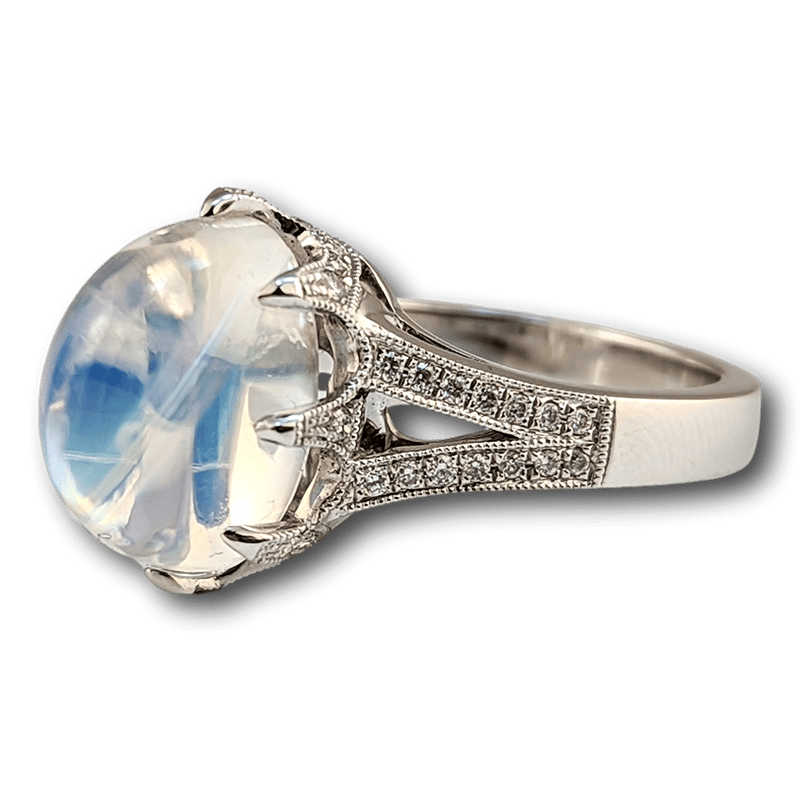

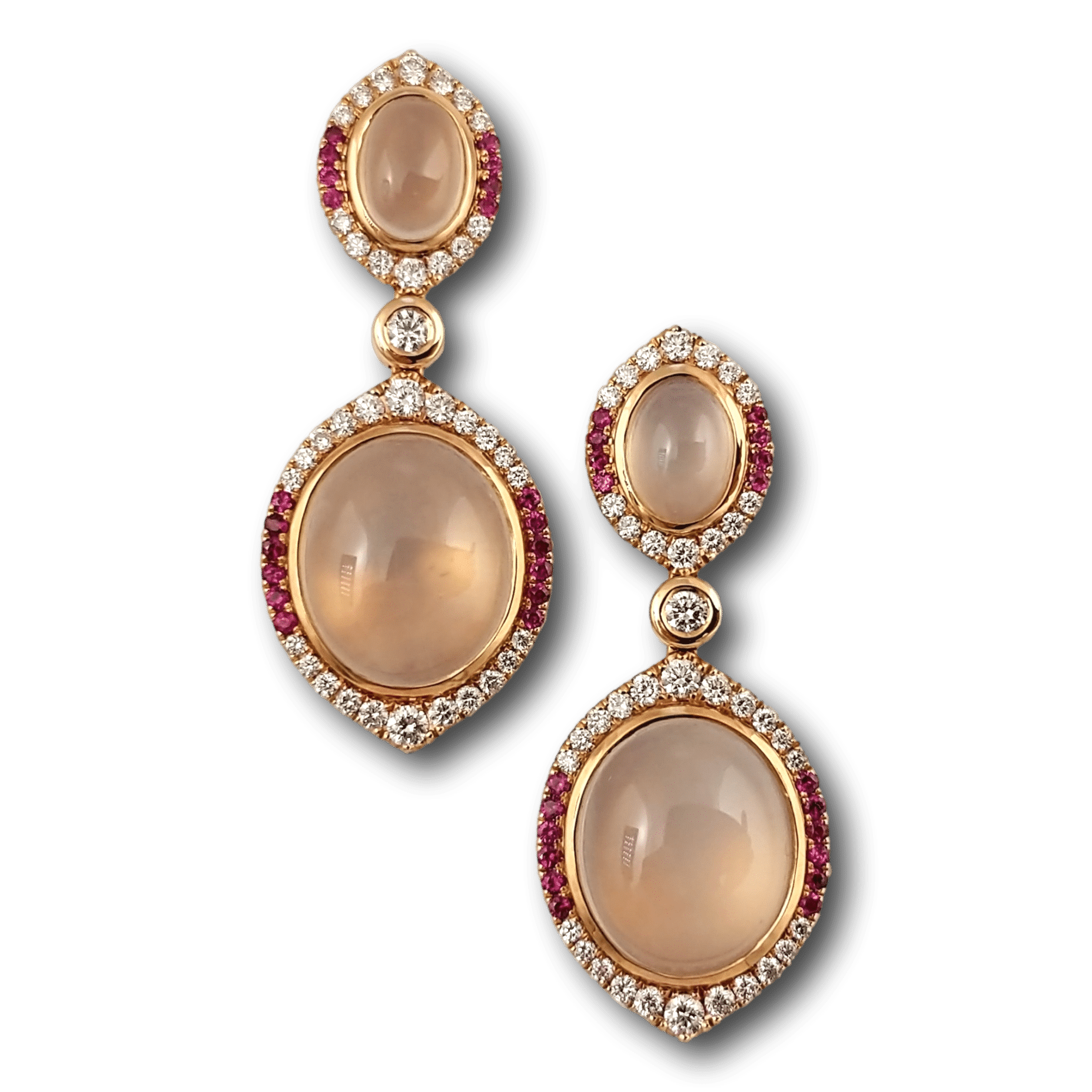
The Source of Moonstone’s Glow
The term adularescence comes from Mount Adular in Switzerland, an early mining location associated with fine moonstone.
The glow appears when light bends as it passes through alternating internal layers of feldspar minerals.
The effect shifts as the stone moves or as lighting conditions change. A moonstone can appear quiet in one moment, then luminous in the next when tilted or worn in motion.
Ancient writers noticed this behavior long before modern gemology defined it. Roman historian Pliny the Elder described moonstone as changing with the phases of the moon, an observation still referenced in classical gem history sources.
Moonstone Colors and Visual Range
The most highly valued moonstones are nearly colorless with a strong blue adularescence. These stones are increasingly rare, and prices reflect the limited availability of fine material.
Moonstone also appears in a wide range of body colors, including:
- White and translucent
- Peach and soft orange
- Layered gray tones
- Green
- Yellow
- Brown
- Pink
The glow itself may appear white, silvery, or blue, depending on the stone’s internal structure and how it is cut.
Some stones display a vivid blue flash across the surface. These are especially sought after for their clarity and intensity.
Others show multiple colors of light and are commonly sold as rainbow moonstone. While rainbow moonstone is technically a form of labradorite, it is widely accepted in the jewelry trade and often grouped with traditional moonstone varieties in fine jewelry collections.
Cultural Associations and Meaning
Moonstone has historically been linked to reflection and transition rather than status or protection. Across different cultures, it has been associated with cycles, emotional awareness, and personal change.
Common symbolic associations include:
- Periods of renewal
- Emotional steadiness
- Creative awareness
These meanings are cultural rather than scientific, but they help explain why moonstone is often chosen to mark personal milestones that feel inward and reflective rather than ceremonial.
How Moonstone Is Used in Jewelry
Moonstone is most often cut as a cabochon. This smooth, rounded shape allows light to move freely through the stone, which enhances adularescence. Faceted moonstones exist, but the glow is usually softer and less consistent in faceted cuts.
On the Mohs hardness scale, moonstone ranks around 6 to 6.5. This makes it suitable for daily wear when paired with thoughtful design. Protective settings help preserve the surface and edges over time.
Moonstone is well-suited for:
- Earrings and pendants, where the impact risk is minimal
- Rings with bezel or partial bezel settings
- Designs that emphasize proportion and balance rather than heavy accent stones
It pairs naturally with white metals that echo its cool tones, as well as yellow gold, which adds warmth without overwhelming the stone.
Care and Wear Considerations
Moonstone benefits from gentle care due to its layered internal structure.
Recommended practices include:
- Cleaning with warm water, mild soap, and a soft cloth
- Avoiding ultrasonic and steam cleaners
- Removing moonstone jewelry during physical work or exercise
- Storing separately from harder stones such as diamonds
Many of these guidelines overlap with pearl care. Our jewelry cleaning and care guide outlines safe practices for softer gemstones in more detail.
Choosing a June Birthstone
June offers more flexibility than most months. Pearl appeals to those who value organic texture and long-standing tradition. Alexandrite attracts collectors drawn to rarity and color change. Moonstone suits people who prefer subtle movement and a quieter visual presence.
There is no hierarchy among June’s birthstones. The best choice depends on how the stone feels when worn and how it fits into everyday life. Comparing moonstone alongside pearl jewelry or alexandrite in person often makes the differences immediately clear.
Explore Moonstone Jewelry at Copeland Jewelers
Moonstone remains one of June’s most expressive birthstones. Its glow does not compete for attention, but it rewards it.
At Copeland Jewelers, we help clients evaluate moonstone based on glow, cut, and durability, with attention to how the piece will actually be worn over time. The focus is always on proportion, comfort, and choosing stones that continue to feel right long after the first impression.